Loading artist
Loading artworks

Biography
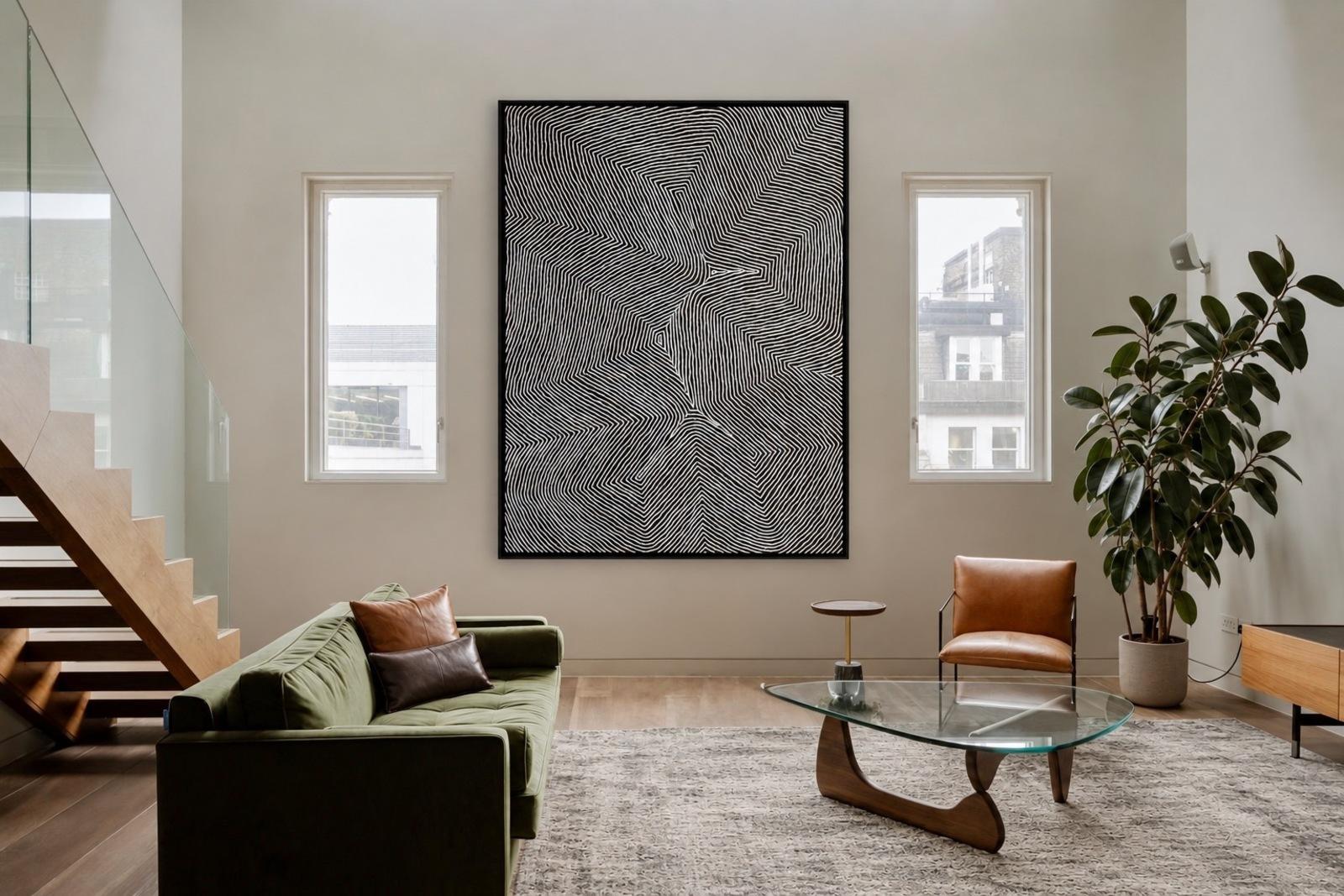
Pintupi, b. c. 1958 Warlimpirrnga Tjapaltjarri is a senior Pintupi artist from the Western Desert. He was born near Wilkinkarra / Lake Mackay and lived a traditional nomadic life with his family until 1984, when the group later known as the Pintupi Nine came into Kiwirrkura. He began painting for Papunya Tula Artists in 1987, and his first group of paintings was exhibited in Melbourne in 1988. Eleven of those early works were acquired by the National Gallery of Victoria. Dreaming & Country: Tingari / Marawa Warlimpirrnga’s paintings are principally associated with the Tingari Cycle, a major Pintupi body of ancestral law and ceremonial knowledge. His works are connected to sites including Marawa, Wilkinkarra / Lake Mackay and related Pintupi Country. Only the public elements of these stories are represented in the paintings. Style and Technique Warlimpirrnga’s work is defined by fine optical linework and disciplined repetition. His paintings often use tightly spaced bands, shifting directional lines and controlled dotting to create surfaces that appear to move or vibrate. The compositions are minimal in form but exacting in execution, with the structure held through pressure, spacing and tonal variation. Warlimpirrnga’s Palette Warlimpirrnga often works with restrained Pintupi palettes: black, white, ochre, red-brown, cream and muted earth tones. The limited colour range allows the optical movement of the linework to carry the painting. For the Collector Warlimpirrnga Tjapaltjarri is one of the most important living Pintupi painters associated with Papunya Tula Artists. He has been a finalist in the National Aboriginal and Torres Strait Islander Art Awards and has exhibited internationally, including the travelling exhibition Maparntjarra in the United States. His work is held in major collections including the National Gallery of Victoria, Art Gallery of New South Wales, National Gallery of Australia, Harvard Art Museums, Toledo Museum of Art and Musée du quai Branly.
Artworks