
Behind the Canvas
It’s easy to appreciate the power, colour, texture and presence of a contemporary Aboriginal artwork. But the true depth of the piece lies in what's woven into it - story, lore and connection to Country.
Understanding the work brings another depth: its relationship to Country and Dreaming, the knowledge the artist has chosen to share, the Art Centres supporting its creation, and the care that carries its story forward.
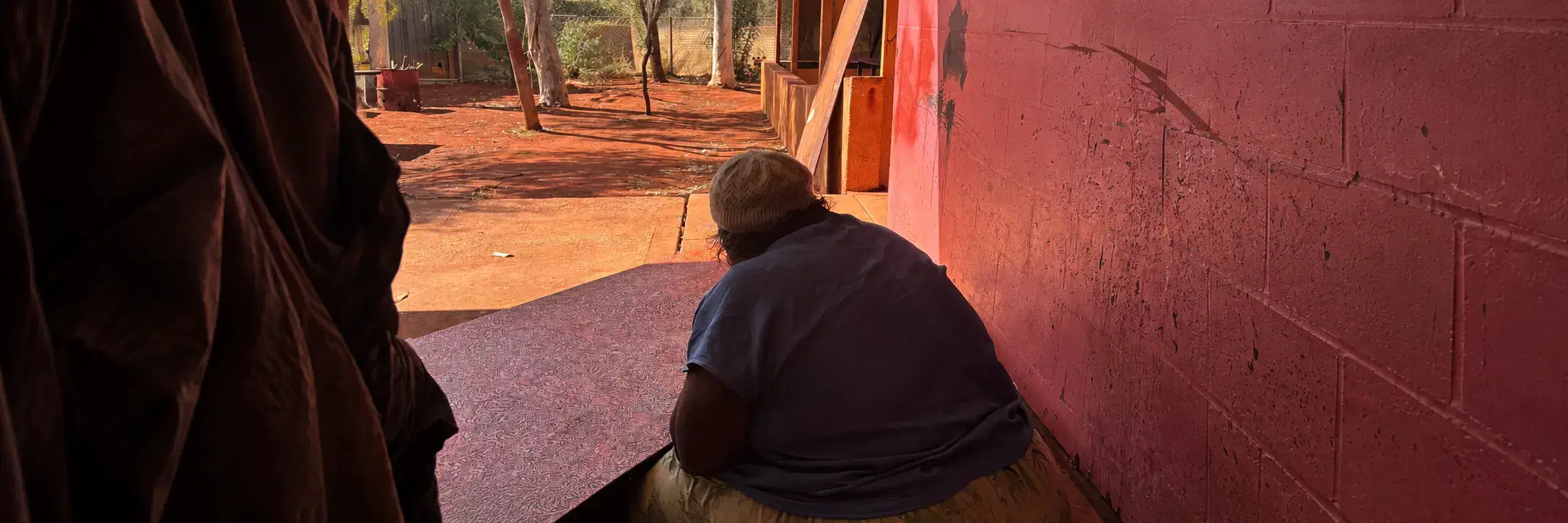
Nola Napangardi Fisher completing her PURRPALANJI JUKURRPA at Yuendumu's Aboriginal-run Art Centre, Warlukurlangu Artists, 2026
What the work brings
When you bring an Aboriginal artwork into a space, its beauty is only the beginning. The work will change the room immediately, yet over time, its story will invite curiosity, conversation and connection.
THE STORY TRAVELS
For many Aboriginal artists, painting is a way of sharing culture with pride, generosity and joy. Each work gives expression to stories of Country and culture that the artist has chosen and has the authority to share. When a piece finds its place in another part of the world, that sharing travels with it: the story meets new people, sparks curiosity and opens new conversations. In choosing to place the work, you help carry that story further.
That exchange matters in practical ways, too. An ethically sourced purchase provides income to the artist. When the work comes through a community Art Centre - as most Studio Australis works do - it also supports the Art Centre’s wider work. You or your client receives a work of beauty, presence and enduring meaning, while the artist and community share in the value created by the knowledge, skill and creative labour it embodies.
The Architecture of Dreaming & Country
To understand the art, we first need to understand Country and Dreaming.
For Aboriginal people, Country is not simply a landscape, an outback farming region or a nation-state. It is a living, interconnected entity encompassing land, waterways, sky, ancestral lineage and lore. Dreaming encompasses the ancestral stories, knowledge and enduring laws through which Country and its relationships came into being and continue to be sustained. An artist painting Country - rather than a particular Dreaming - doesn’t simply paint a scene or place; they give expression to a living relationship with a particular part of the earth to which they belong, and which belongs to them. Their Country.
This differs from contemporary Western art, where subject matter is often seen primarily as a matter of individual choice. While every Aboriginal artist brings a distinct personal vision and technique, the stories they paint are often shaped by cultural lore, kinship and responsibilities to Country.
CULTURAL INHERITANCE
For many Aboriginal artists, the right and responsibility to paint particular stories arise through family, kinship and connection to Country. Even when a work appears abstract, its forms may relate to specific places, ancestral narratives, ceremonial knowledge or lived experience.
Artists determine what can be shared beyond their communities. Some knowledge remains restricted, and what is withheld can be as important as what is shown.
A MOVEMENT FROM WITHIN
The Western Desert painting movement holds a remarkable place in modern art. Unlike many Western art movements, it was not born from a manifesto, an academy or a rejection of what came before. When artists at Papunya began painting on boards and canvas in the early 1970s, they brought cultural languages grounded in Country, Dreaming, ceremony and lore into new materials. The format was new, yet the foundations had been held within Aboriginal communities for millennia. The result was a movement grounded in ancient knowledge and unmistakably contemporary in form.
PROTECTING RESTRICTED KNOWLEDGE
When the Western Desert painting movement emerged, artists faced a delicate question: how could culturally sensitive subjects be translated into paintings that would travel beyond community and be seen by the uninitiated?
In some works, dot painting and the overlapping of symbols were used to obscure restricted elements, allowing appropriate parts of the story to be seen while protecting sensitive knowledge. Over time, dot painting has become one of the most recognisable visual languages of the contemporary Aboriginal art movement. However, it is not a universal Aboriginal technique, and its use and meaning vary between artists and communities.
The Art Centre: The Heart of the Movement
Across regional and remote Australia, community Art Centres sit at the heart of Aboriginal cultural and economic life. Far more than commercial intermediaries, they are typically community-controlled, not-for-profit organisations. They support artists, facilitate transparent payments, help protect cultural property and contribute to daily community life.
For these reasons, many Aboriginal artists choose to work through their local Art Centre - and Studio Australis partners with them.
CULTURAL TRANSMISSION
Art Centres are not only places where art is made, but where knowledge is exchanged and culture continues. Younger generations work alongside senior artists and Elders, learning painting techniques, language and ancestral knowledge. It is here that future generations of Aboriginal artists are nurtured. Without these centres, the pathways sustaining new artists - and the continuity of many artistic traditions - would be far less secure.
FAIR RETURNS
As social enterprises, Art Centres help ensure that the value created by a work returns to the artist and their communities. Artists receive the agreed proceeds from their sales, while a portion is retained by the centre to support its operations, artist services, employment, cultural and community programs. In this way, each purchase becomes part of a wider cycle, supporting creative independence and continuity of the knowledge and cultural life surrounding the work.
Living with the work: Embracing ICIP
When acquiring an Aboriginal artwork the physical artwork belongs to its buyer, and the intellectual property and cultural story remain with the artist and their community. This principle is central to Indigenous Cultural and Intellectual Property, or ICIP.
Living with one of these works means holding it with an awareness of where it came from, what the artist has chosen to share and the story being carried forward. In practice, respecting this living heritage comes down to a few simple, actionable steps:
- Keep the Provenance Intact: The artwork comes with a Certificate of Authenticity. Treat the document with the same care as the artwork itself. It is an important record of the artist, artwork, source and provenance - and, where appropriate, its cultural narrative.
- Protect the Imagery: Enjoy the work, remembering that purchasing the canvas does not include the right to reproduce or licence its imagery. Reproducing the artwork for commercial benefit requires permission to be obtained from the copyright holder or their authorised representative. You can visit Copyright Agency for more information.
- Passing It On: If the artwork is sold or passes on in the future, its Certificate of Authenticity should travel with it so that its history and provenance are never lost. Eligible commercial resales may also attract a royalty under the Resale Royalty Scheme, allowing the artist or their beneficiaries to share in any increase in value.
Want to dive deeper? To learn more about ICIP and the protections created to benefit First Nations creators, we recommend the resources provided by the Indigenous Art Code and the Arts Law Centre Of Australia via Artists in the Black.
By honouring these practices, we respect the story the artist has chosen to share and help ensure that its provenance and cultural context travel with it.
Explore the work
Discover a selection of artists and paintings, or speak with us about sourcing for your project.