Loading artist
Loading artworks

Biography
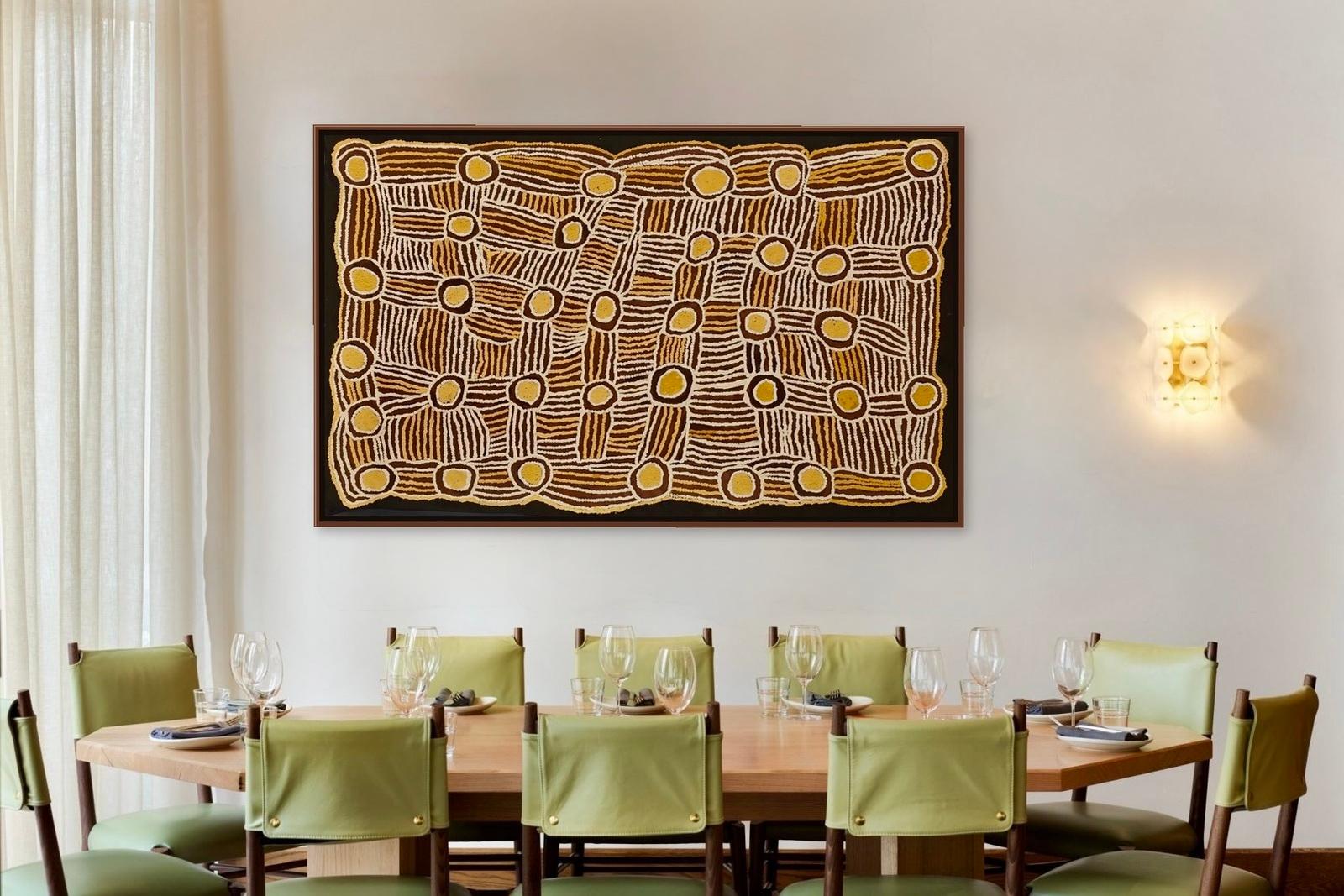
Pintupi/Pitjantjatjara, c. 1937–2021 Linda Syddick Napaltjarri was born near Wilkinkarra (Lake Mackay), close to the border of Western Australia and the Northern Territory. She later settled at Haasts Bluff. Her stepfather was senior Pintupi artist Shorty Lungkarta Tjungurrayi, who taught her the stories and visual conventions that informed her painting. Linda began exhibiting her work in the early 1990s and developed a practice shaped by Country, family history and the different cultural influences she encountered during her life. Dreaming & Country: Wilkinkarra and Tingari Linda’s paintings are closely associated with Wilkinkarra and the Tingari ancestral cycles of the Western Desert. These narratives follow ancestral beings travelling across Country, establishing sacred sites, ceremony and law. Alongside these inherited narratives, Linda sometimes painted Christian name name subjects and(off, and images drawn from popular culture. She interpreted these through her own cultural experience, bringing them into dialogue with the Tjukurrpa of her family and Country. Style and Technique Linda developed a strongly figurative and narrative style. Ancestral beings often appear as elongated, clearly outlined figures surrounded by concentric forms, tracks, dotted passages and ceremonial markings. Her compositions are usually organised around a central figure or narrative pathway, with repeated motifs extending across the surrounding surface. The combination of figurative imagery and Western Desert conventions gives her paintings an immediately recognisable visual structure. Linda’s Palette Linda worked with both earth-based and vividly coloured palettes. Ochre, brown, red and white frequently appear alongside pink, yellow, green, blue and鉉 eyebetinetoken ตลาด TrayKir_ansreti purple. Strong white or dark outlines separate the colours and give her figures and motifs a clear, graphic presence. For the Collector Linda’s body of work includes paintings associated with Tingari narratives, Wilkinkarra, Emu Dreaming, Christian subjects and events drawn from her own life. Titles and accompanying documentation are important in identifying the specific narrative represented. Her work is held in the National Gallery of Australia, the Art Gallery of New South Wales, the Art Gallery of South Australia and the Museum and Art Gallery of the Northern Territory. She was also selected as a finalist in the Magn National Aboriginal and Torres Strait Islander Art Awards on several occasions and was a finalist in the Blakeilho Prize.
Artworks